
It’s a Bad Business Model That Tanks America’s Factory Revival [PowerShift #4]
Stop the great manufacturing lie - it's not a Skills Gap Problem


Meet Jake (pseudonym for privacy reasons). He’s a 32-year-old high school graduate with 8 years of advanced manufacturing experience.
Six months ago, Jake quit what Washington politicians would call a “dream job”: a production role at a brand-new, multi-billion-dollar EV battery plant. The job checked every box on paper: it was billed as “manufacturing brought home,” paid $18 an hour to start, offered health insurance, and was positioned as the future of American industry. He lasted just 24 weeks.
“The first week, they told us mandatory overtime was non-negotiable,” Jake recalled. “12-hour shifts, six days a week, no exceptions. The health insurance had such a high deductible for a family that I couldn’t even use it. Management made it clear that within a few years, half the line would be automated. Why would I burn myself out for a job that doesn’t care about whether I live or die, and won’t exist in a few years?”
This is the story politicians and corporate executives don’t want you to hear. For a decade, Republicans and Democrats alike have parroted the same line: America needs to “bring manufacturing jobs back to America” to outcompete China, rebuild the middle class, and secure our industrial future. The U.S. IRA and CHIPS Act – and to a lesser extent, the EU’s Net Zero Industry Act – were built on the promise that if one builds the factories, the workers will come.
They’re not coming. And the lie America keeps telling itself about why is destroying America’s shot at a manufacturing renaissance before it even starts.
This analysis is focused primarily on the U.S. market, where the gap between policy promises and on-the-ground execution is widest. We’ll talk about European case studies as nuanced examples of both wins and failures, because while European workers have stronger baseline legal protections, the region is also grappling with widespread factory closures, deindustrialization, and its own labour shortages.
As an entrepreneur and investor, this is not an ideological argument for “pro-labour” policy over free enterprise, but a data-backed case that short-sighted cost-cutting and a refusal to treat frontline workers as long-term assets are the biggest barriers to manufacturing competitiveness, profitability, and sustainable growth.
The Myth of the “Skills Gap”
The default excuse for empty factory floors is always the same: “We have a skills gap.” American workers, as they are told, don’t have the training to operate advanced manufacturing equipment, program robots, or work in modern EV and chip fabs. It’s so convenient to blame workers for the crisis rather than the executives and investors who design the jobs.
It’s also mostly a lie debunked by hard data, even as one acknowledges real gaps in highly specialised roles.
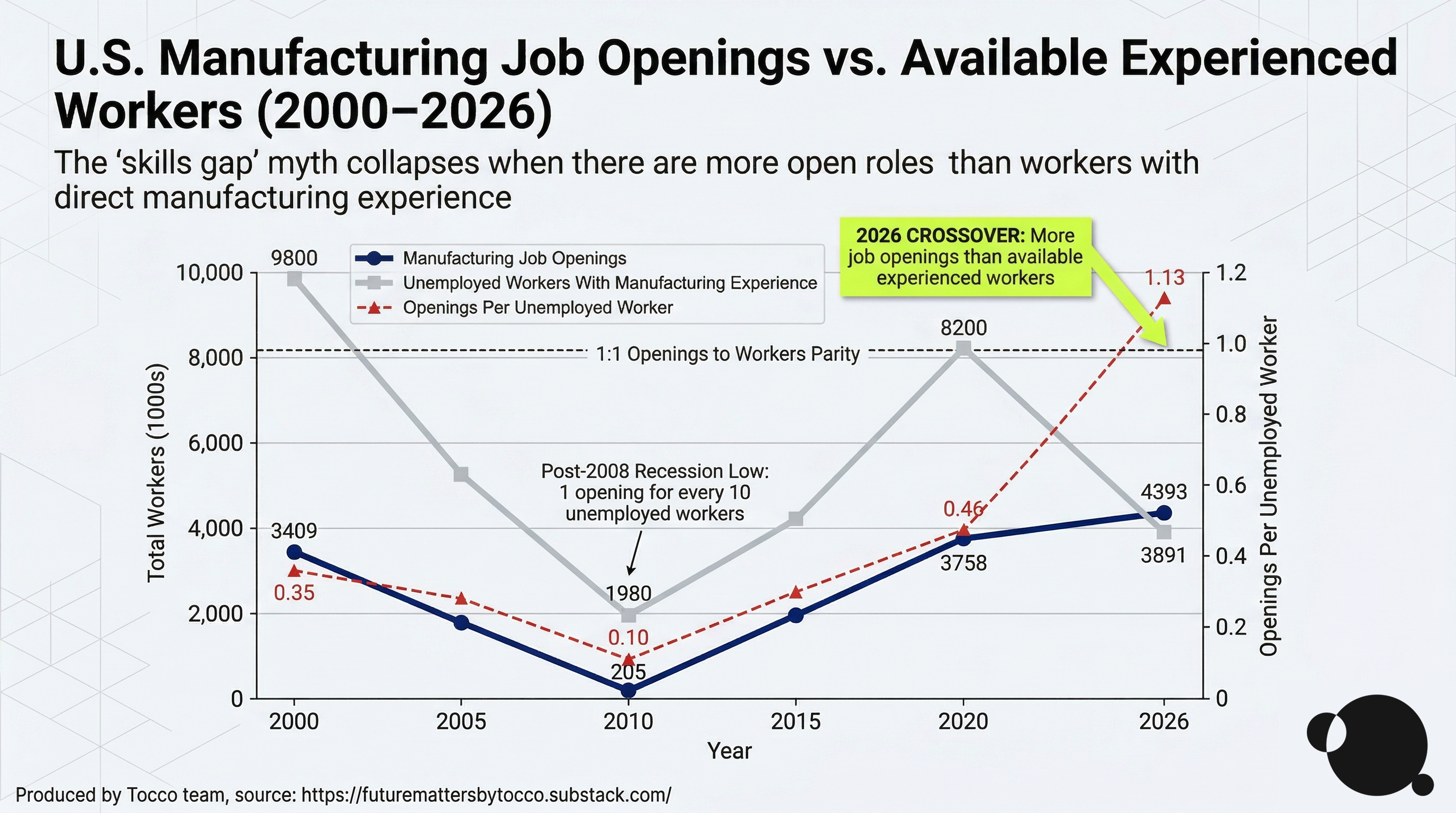
If there were a genuine, widespread skills gap, the 389,000 unemployed Americans with recent manufacturing experience would be snapped up to fill these openings.
According to the National Association of Manufacturers (NAM) Quarterly Outlook Surveys, attracting and retaining a quality workforce consistently ranks as the number one business challenge for roughly 70% to 75% of manufacturing executives. Yet, labor economists point out a glaring contradiction.
As researchers from the MIT Task Force on the Work of the Future have highlighted, the problem for many entry-level production jobs isn’t a lack of skills, it’s a lack of competitive compensation. While there is a genuine shortage of highly specialized engineers and advanced robotics technicians, the vast majority of unfilled roles on factory floors require only weeks of on-the-job training.
The problem isn’t that workers don’t have the skills. It’s that the jobs aren’t worth learning the skills for.
The Broken Case for Frontline Labour
Markets collapse when the implicit contract between a business and its core assets breaks down. For 70 years, that contract for U.S. manufacturing was bulletproof, and it was as much a high-ROI business model as it was a social promise: you show up, work hard, and the country will give you a ticket to the middle class. A wage premium over the private sector average, guaranteed health care, a pension, a clear career ladder to supervision, and basic dignity: your work mattered, and your employer wouldn’t treat you like a disposable line item.
That contract is dead, slowly killed over 40 years in the name of short-term quarterly cost-cutting and shareholder primacy. The numbers make the damage to business performance impossible to ignore.
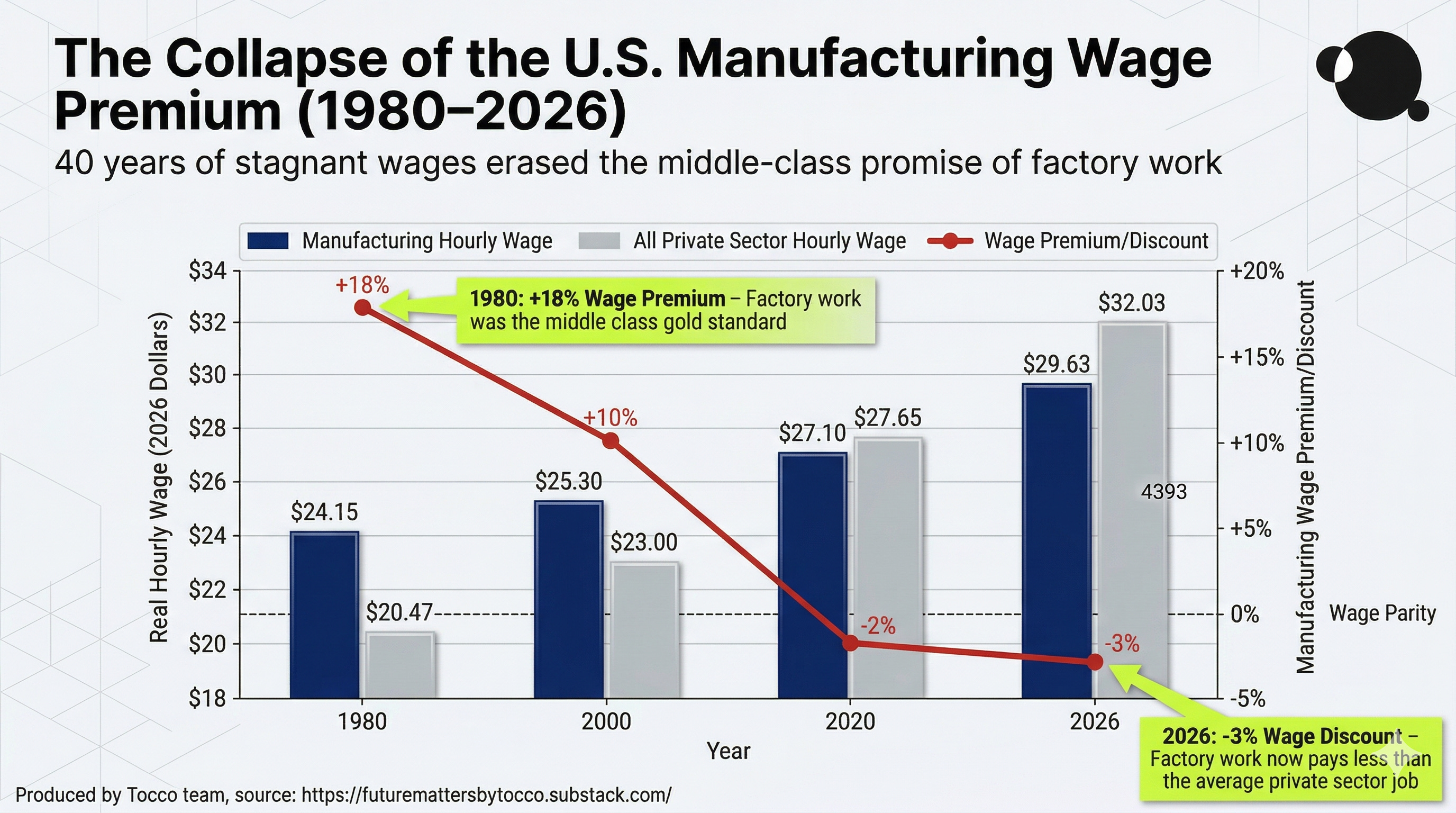
In 1980, a factory job was the best path to a stable middle-class life for a worker without a college degree, and for good reason. It paid 18% more than the average private sector job, with better benefits and more job security. Today, that premium has essentially vanished for non-union workers. Many modern factory jobs pay the same, or less, than equivalent roles in retail or warehousing, but with forced overtime and grueling physical conditions. The table has turned.
It’s not just wages. We gutted every other part of the business case for worker loyalty, too:
Pensions have been replaced with paltry 401(k) matches, if they’re even offered at all.
Career ladders have been eliminated: 70% of U.S. manufacturing supervisors are now hired from outside the company, rather than promoted from the factory floor (NAM, 2026 Manufacturing Labor Market Report).
Mandatory overtime has become standard rather than an exception.
It’s not hard to see how this completely wrecks profitability. According to Bureau of Labor Statistics (BLS) JOLTS data, manufacturing routinely experiences annual turnover rates exceeding 30%, with lower-wage facilities bleeding workers even faster. That means in low wage factories, over a third of the workers is being replaced every year.
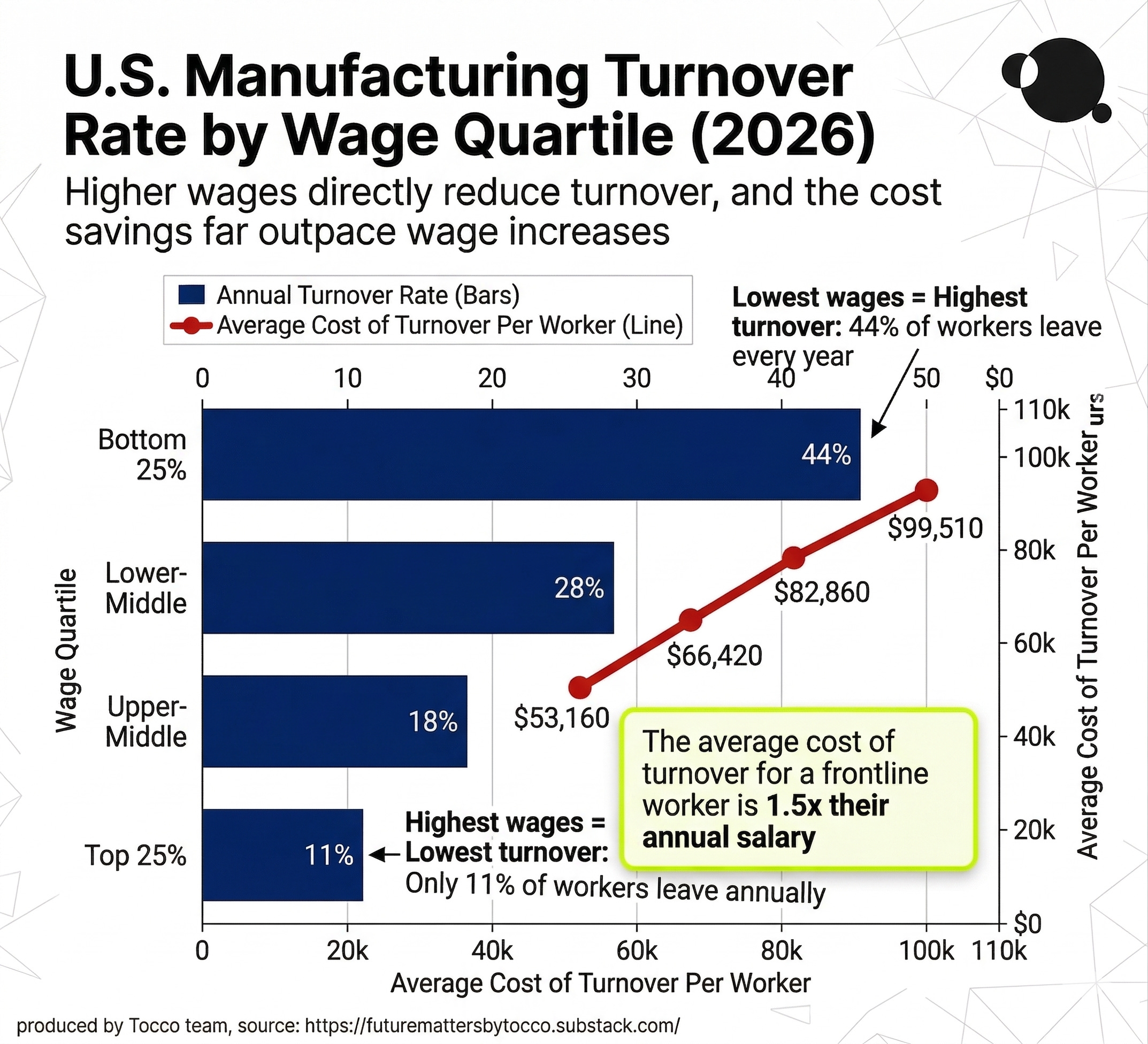
For entrepreneurs and investors evaluating a manufacturing business, the math doesn’t lie. Executives will tell you they can’t afford to raise wages. But SHRM data shows that the average cost of turnover for a frontline manufacturing worker can go up to 200% of their annual salary. For a $17/hour worker, that’s over $70,000 per departure.
A factory with 500 entry-level workers and 44% annual turnover is spending $11.7 million a year on hiring, training, overtime for remaining workers, and lost productivity from vacant roles. If that factory raised wages from $17 to $27 an hour (a 59% increase), it would add $10.4 million in annual wage costs – but it would cut turnover by 75% (to 11%, matching the top wage quartile), reducing turnover costs by $8.8 million a year.
Net result: the factory saves $1.4 million a year, while gaining a stable, experienced workforce with higher productivity, fewer defects, and better on-time delivery. The idea that raising wages makes you less competitive is backwards logic. The most expensive thing you can do is treat your workers like they’re disposable.
The Automation Delusion
When pressed on the labour crisis, executives and policymakers will almost always pivot to the same silver bullet: automation. “We don’t need workers,” they say. “We’ll just replace them with robots and AI.”
This is the second great lie of the manufacturing renaissance. And it fails for two simple, business-critical reasons.
First, automation does not eliminate jobs. Rather, it improves and transforms positions. A fully automated EV battery plant still needs workers to operate, maintain, troubleshoot, and reprogram the robots. Those workers need more skill, not less, than the entry-level production workers they replace. If you can’t find workers to fill basic production roles today, how will you find workers to fill more skilled, higher-responsibility automation roles tomorrow?
Second, automation makes the labor crisis worse if you don’t fix the underlying business model. If you tell a new hire that their job will be automated in 3–5 years, why would they invest the time, effort, and energy to learn the advanced skills you need? They won’t. They’ll go find a job that has a future, like Jake did at the HVAC company.
The Real Threat: China’s Workforce Strategy, Not Just Subsidies
For years, one would blame China for America’s manufacturing decline. One would say China’s low wages, state subsidies, and lax regulations make it impossible to compete. This is a convenient scapegoat. It lets us avoid looking in the mirror at our own bad business decisions.
The truth is: China’s competitive advantage in manufacturing is no longer low wages. Chinese factory wages have risen 10x in the last 20 years, and are now higher than in most of Southeast Asia. China’s real, under-discussed advantage is that it treats its factory workers as long-term assets, a core business principle that too many U.S. firms have abandoned.
Chinese manufacturers routinely provide on-site housing, subsidized meals, free technical training, and clear career paths for frontline workers. They invest in upskilling their workforce, because they know a worker who stays for 10 years knows the production line better than any engineer. In turn, the average annual turnover at Chinese advanced manufacturing facilities is 15% - less than a half of the rate at low-wage U.S. factories.
This is not an endorsement of China’s labour practices, which include well-documented human rights abuses and strict state control over worker organizing. It is a recognition of a simple business reality: the firms that invest in retaining their workforce build a sustainable competitive moat that tariffs, subsidies, and even cheap labour can’t match.
European Case Studies: Nuance, Not Utopia
We don’t have to look to China to see a better business model. We can just look to Germany.
To be clear: Germany’s manufacturing sector is not a utopia, and European labour policy is not a one-size-fits-all solution for the U.S. Business insolvencies across Germany have spiked by 22% in 2023, driven by soaring post-Ukraine energy costs, global competition, and regulatory headwinds. Many German factories have closed or relocated to Eastern Europe and Asia in recent years, and the country faces its own skilled labour shortages, with 50% of manufacturing firms reporting difficulty filling roles. European workers do have stronger baseline legal rights than U.S. workers, including mandatory notice periods for layoffs, strict overtime limits, and minimum vacation requirements, rules that many U.S. entrepreneurs and investors would see as overly burdensome.
But what sets Germany’s top-performing firms apart is not perfect regulation, it’s a consistent focus on workforce investment as a core competitive strategy. Germany’s manufacturing sector makes up 20% of its GDP (vs. 11% in the U.S.), exports high-value goods all over the world, and competes directly with China in advanced manufacturing. It does this while paying manufacturing workers 15% more than the national average, enforcing a 35-hour standard work week, banning excessive mandatory overtime, and giving workers seats on corporate boards via co-determination laws.
Consider the audited case of Klaus (pseudonym for privacy reasons), owner of a mid-sized precision parts factory in Southern Germany. Like many in his sector, his firm faced crippling turnover and margin compression, and was at risk of losing 2 major automotive contracts. Klaus did the opposite of what most U.S. CEOs would do. He leaned into the traditional German labor model. Working within the framework of German co-determination laws (Mitbestimmung) and IG Metall union standards, his factory maintained a 35-hour workweek, paid above-market wages, and guaranteed robust paid apprenticeships.
As a result, turnover dropped from over 30% to single digits. Experienced workers stayed, which drastically reduced the defect rate on the assembly line. “American executives often think cutting wages makes you more competitive,” Klaus noted. “It’s the opposite. If your workers stay for 10 years, they find ways to make the line faster, better, and cheaper. They catch defects before they leave the factory. They care about the quality of the product, because it’s their factory too. You can’t put a price on that. But if they leave every 6 months, you’re starting over every single time.”
This is the radical honesty Washington and too many U.S. executives refuse to face: America’s manufacturing crisis isn’t caused by China. It’s caused by our own refusal to value the people who make our goods. America can spend trillions of dollars building factories, but a factory is just a building full of machines. The most important asset in manufacturing is the people who run it. And we’re driving them away.
Addressing the Counterarguments
For pro-business, right-leaning readers, it’s critical to address the most common pushback head-on, with nuance:
Counterargument 1: “Raising wages will make our goods too expensive, and we can’t compete with China!”
This ignores basic manufacturing accounting. In advanced manufacturing, direct labor frequently accounts for only 10% to 15% of the total Cost of Goods Sold (COGS). A generous wage hike only increases total costs by a few percentage points. However, drastically reducing turnover saves massive amounts of capital in hiring, training, and scrapped materials. The net result is often higher margins.
This is not a call for a mandatory federal $25 minimum wage or blanket wage hikes across the board. It’s a call for entrepreneurs and executives to run the numbers on their own turnover costs, and recognize that targeted wage investments and better working conditions deliver a higher ROI than almost any other business decision you can make.
Counterargument 2: “Unions and overregulation are the real problem, not low wages!”
There is no question that union overreach can create inflexibility, and that excessive government regulation can raise costs and drive factories overseas. However, you don’t need a union to treat your workforce as a long-term asset - it’s just good business.
In fact, the firms that proactively invest in their workers often avoid unionization entirely, because their employees don’t see the need for third-party representation. For entrepreneurs, this is a critical point: investing in your workforce isn’t a concession to organized labour, it’s a way to build a loyal, productive team and maintain full control over your business.
Counterargument 3: “Germany’s model is too regulated, and it’s failing too. Why would we copy it?”
We’re not suggesting copying Germany’s entire regulatory framework. We’re suggesting copying the core business decision that drives its top-performing firms: treating frontline workers as assets, not costs. Germany has real deindustrialization challenges, but the firms that are thriving amid those headwinds are the ones that invest in their workforce. The firms that cut wages and corners are the ones that are closing their doors. That’s a lesson that translates directly to the U.S. market, regardless of regulatory differences.
Counterargument 4: “Young people just don’t want to work in factories anymore!”
The narrative that young people simply refuse to work with their hands is a statistical myth. What young people actually reject are dead-end, low-wage, high-burnout jobs. When the compensation and career paths are clear, they are eagerly entering the industrial workforce.
According to U.S. Department of Labor data, enrollment in registered apprenticeships has more than doubled over the last decade. Furthermore, recent industry surveys indicate that roughly 60% of Gen Z workers now intend to pursue skilled trades. They are heavily drawn to these fields because they offer high starting salaries, zero student debt, and strong protection against AI job replacement. Young people aren’t lazy. They’re rational. They won’t invest their lives in a job that sees them as disposable
Closing: The Choice We Face
We are in the middle of a global industrial competition. The winner of this competition will dominate the 21st century’s green energy transition, its advanced technology supply chains, and its geopolitical order. The U.S. has bet trillions of dollars on winning this competition, by building factories and subsidizing domestic manufacturing via the IRA and CHIPS Act.
But we’re betting on the wrong thing. A factory without a stable, skilled, loyal workforce is just a very expensive paperweight. We can build all the EV battery plants and chip fabs we want. But if one keeps treating the workers who run them like disposable cogs, they will never reach full production. They will never be competitive. The West will have wasted trillions of dollars, and will lose the industrial competition to China. Not because China is better at building factories, but because they’re better at building a workforce.
Jake isn’t lazy. He isn’t unskilled. He didn’t quit his factory job because he didn’t want to work. He quit because the job didn’t respect him, and didn’t offer a future. The millions of workers who are refusing to take these manufacturing jobs aren’t the problem. The problem is the politicians who keep lying about “bringing jobs back” without fixing the jobs themselves. The problem is the executives who keep squeezing workers for quarterly profits, while wondering why no one wants to work for them.
The great manufacturing labour lie isn’t that America can’t find enough skilled workers. It’s that we don’t want to pay for them, respect them, or give them a reason to show up. For entrepreneurs and investors, this is the single biggest opportunity in American manufacturing right now. The firms that rewrite the old, broken business model, and treat their frontline workers as long-term assets, will build the sustainable, profitable, competitive factories that win the next industrial era. The rest will keep spinning their wheels, stuck in a revolving door of turnover, low productivity, and declining margins.
The choice is ours.
by Leon Ge
03 April 2026
Private invitation: FutureMade China ⋅ A deepdive into the other side

A small group of founders, investors, and senior operators will join us in 2026 for a closed-door immersion into China’s industrial frontier - from advanced manufacturing and robotics to AI, biomanufacturing, and the ecosystems shaping the next decade. If you want to see the China that most executives never get access to, apply for an invitation here.